
Farmers dig deeper into stream health

After a busy few months on farm, the Lagmhor Westerfield catchment group are gearing up to get into the swing of things again as spring kicks in.
We have continued to monitor nitrate levels within the community, using Mid Canterbury Catchment Collectives (MCCC) nitrate probe, and are delving into understanding the health of a waterway in a broader sense.
One of the biggest focuses of the group when it was first formed was biodiversity.
We didn’t know what to plant, how to plant successfully, and where the best bang for buck was.
After receiving some training on stream health assessments, through MCCC, we have started the process of completing stream health assessments of the waterways in our catchment area.
Here we are looking at the streambed for plant growth, algal growth and sediment; water, for clarity, flow, temperature and conductivity; streambank, for plants and erosion; and using a net to capture and identify bugs and larger life forms.
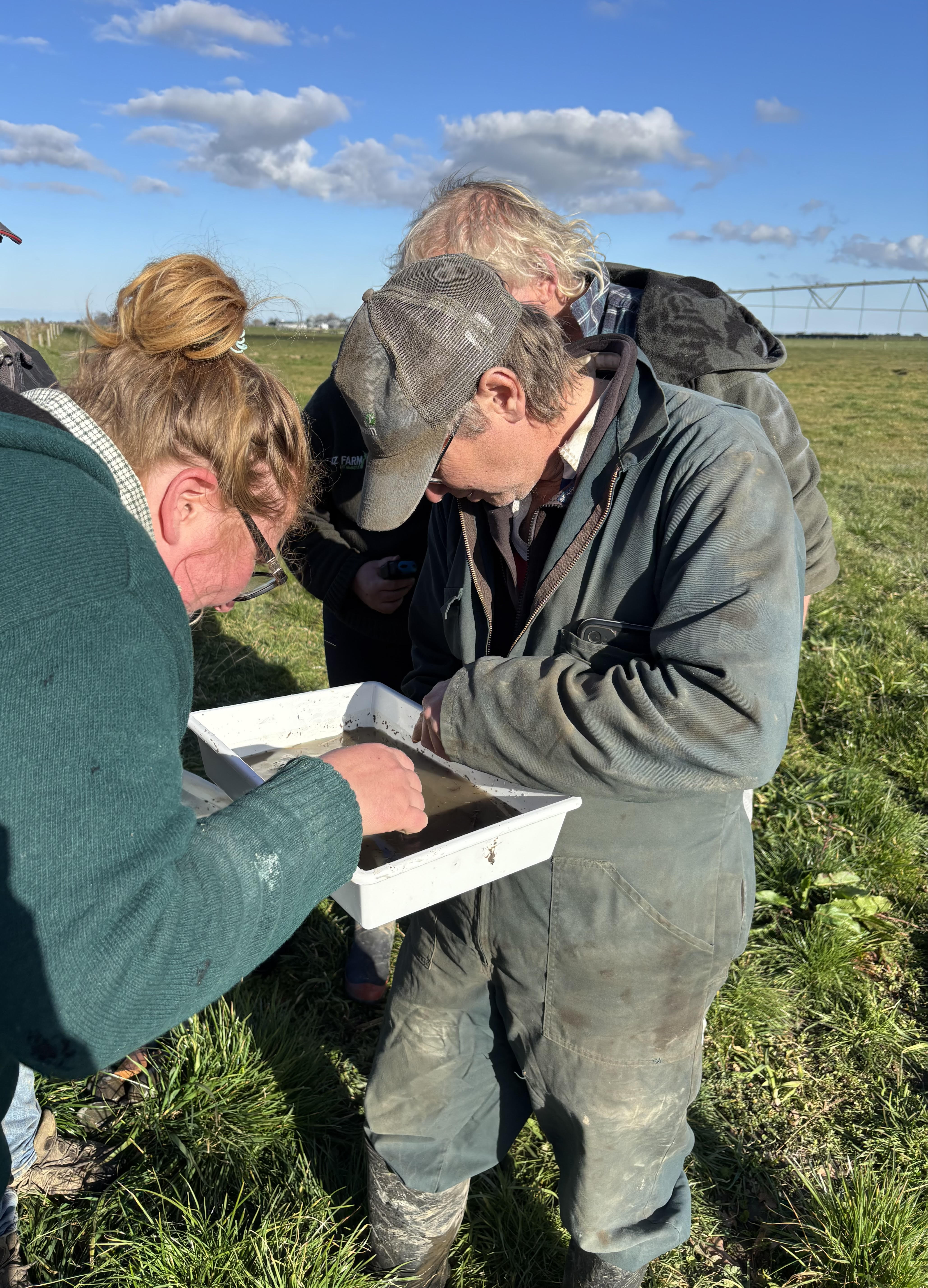
This has been a great interactive tool to get people involved and thinking about the surface water body health more holistically than just focusing in on nitrates.
In the next little while, we will also be taking some eDNA samples of the waterways. These have been funded by MCCC and provide a more detailed list of the type of vertebrates and invertebrates that are present in the water way.
We are looking forward to seeing the analysis of these samples and finding out if there is anything exciting present.
Come some warmer weather, we will get into some more riparian planting individually on farm.
The eDNA results and stream health assessments will be useful here.
Hopefully, we will be able to make some more calculated decisions on what to plant and where to plant, to best protect what we have and enhance what we need to.
The end of September draws close the end of the original funding that started up MCCC and our catchment groups.
From first meeting in December 2022, the Lagmhor Westerfield catchment group has had some great achievements.
By putting people together in a room, around a spring fed creek, or standing in a paddock; we have allowed a space for farmer led learning, without the scientific numbers, but rather, with hands on experience.
We have gathered nitrate test results from a range of groundwater and surface water sites across two years of testing.
We have undertaken a catch crop investigation at farm scale using different crops and animal classes.
We have held a field day with help from Plant and Food research and their demonstration plots.
We have completed riparian plantings on farm, and as mentioned above are working our way through stream health assessments, eDNA sampling, and further planting.
This has been a great effort by our community in this short period of time, and could not have been done without the funding and support from MCCC.
By Sophie Blair, Lagmhor Westerfield catchment group facilitator .